Our Story
In 1833, our Amish anabaptist ancestors emigrated from Lorraine, France, to the United States to escape religious persecution. They arrived in New York City intending to join Amish settlements in Ohio. However, the land agent for Joseph Bonaparte, Napoleon’s brother, convinced them to purchase land in Lewis County, New York, about 50 miles southeast of the Thousand Islands area of the St. Lawrence River. They were told it was roughly the same latitude as Lorraine, and they could grow grapes there for wine-making. They were misinformed.
When they arrived in Lewis County in the summer of 1833, they found a heavily wooded, extremely rocky terrain in the foothills of the Adirondack Mountains that was hardly amenable to farming. Some of the group continued on to Ontario, Canada, and some left for the original destinations in Ohio, but those who stayed began the arduous task of clearing the land and building a settlement where the village of Croghan now stands. That first year, however, they had little time to construct adequate shelter or put in stores before the onset of a fierce winter of massive snowfall and sub-zero temperatures that is typical for the region.
What saved them was the relationship they had quickly established with the last band of Oneida Indians living in the area. (Most of the Oneidas had already relocated west, perhaps to escape the encroaching European settlers.) Although the Amish were primarily German-speaking, their leaders also knew French in order to communicate with local magistrates in Lorraine and were thus able to communicate with the Oneidas, who had learned the language from French trappers. The Amish were a gentle and unassuming people, quite different from the Europeans the Oneida had dealt with previously, and the groups became friendly. Before the Indians went south to their winter campgrounds in the fall of 1833, they offered the settlers the use of their longhouses. Without this additional shelter, much of the settlement would likely have perished during the first long winter in Lewis County.
In the spring, the Oneidas returned. The new settlers watched in amazement as the Indians made diagonal slashes into the bark of maple trees and collected the sap that dripped out. The sap was poured into hollowed out logs to which hot rocks from a fire were continually added. In this manner, the sap was eventually boiled down sufficiently to produce a sweet, brown maple sugar. The Amish settlers learned this skill from the Oneidas, and their family line has practiced it in Lewis County—with substantial variation in technique and technology—ever since. Today, Samara Sugar Bush is a family owned and operated company comprised of direct descendants of those original Amish settlers. Each spring we take great pleasure in producing 100% pure Grade A New York maple syrup.
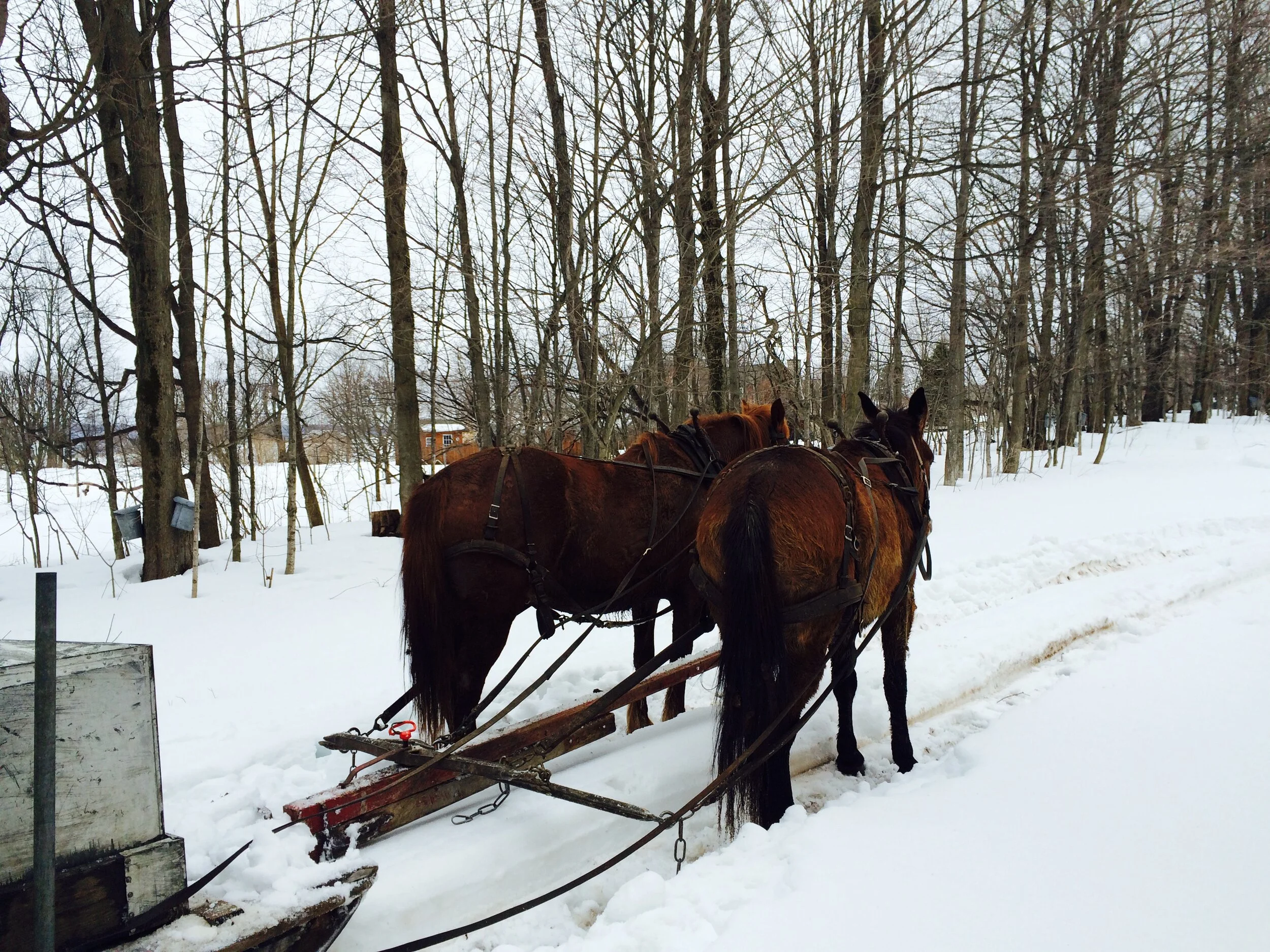
Horses at the Samara Sugar Bush in Castorland, New York